AI Consulting vs. In-House: Complete Cost-Benefit Analysis

Every company building with AI eventually reaches the same fork in the road: hire an internal team or bring in an outside partner. The question carries more weight in 2026 than it did even a year ago. AI talent is scarce, salaries keep climbing, and the gap between a working AI system and an expensive science project is wider than most budgets account for.
This guide breaks down the real numbers, the hidden costs, and the decision factors that matter when you compare an AI consulting company with an in-house build. The goal is simple: help you pick the model that fits your stage, your budget, and the speed your market demands.
The decision rarely comes down to a single spreadsheet line. It touches hiring, retention, timelines, governance, and how much of your roadmap depends on AI working correctly the first time. Get it right and you ship faster than competitors while keeping costs predictable. Get it wrong and you either burn months recruiting for a role you did not fully understand, or you pay premium consulting rates for work that should have lived inside your walls. The sections below give you a framework to avoid both outcomes.
Short Answer: Which Model Wins?
For most companies, an AI consulting company is the faster, lower-risk path to a first working system, especially for a single project or a tight deadline. An in-house team becomes the better economic choice once AI is a core, ongoing function with steady workloads that justify three or more full-time specialists. Many firms run a hybrid model: a consulting partner builds and ships the first systems, then trains internal staff to maintain them.
AI Consulting Services vs. In-House: The Real Cost Breakdown
Headline salary figures hide the true cost of an internal team. Recruiting fees, benefits, equity, tooling, cloud spend, and the months a system sits unfinished all add up. Here is how the two models compare on a like-for-like basis in 2026.
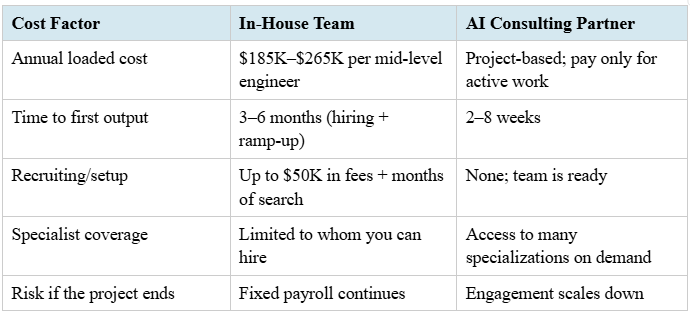
US AI engineer salaries now sit roughly between $125K and $185K, and loaded annual cost for a mid-level hire runs $185K to $265K once bonuses, equity, and benefits are counted. A single bad hire can cost six months and tens of thousands in recruiting fees before recovery even starts.
Consulting rates carry their own range. Big-firm blended rates run $300–$600 per hour, boutique consultancies $150–$300, and offshore or nearshore talent (including India and Latin America) commands a 40–60% discount on US onshore benchmarks. The same engagement can cost $50,000 or $500,000 depending less on quality and more on overhead structure and how much of your spend reaches actual engineering versus slide decks.
The hidden costs are where in-house budgets usually slip. A job posting for a senior AI engineer can sit open for months in a tight market, and every week it stays empty is a week your roadmap waits. Onboarding adds more lag: even a strong hire needs time to learn your data, your stack, and your business rules before producing anything shippable. Then there is the tooling and infrastructure layer, GPU compute, vector databases, monitoring, and evaluation pipelines, none of which appear on a salary line but all of which a working AI system requires.
Consulting engagements fold most of that into a single rate. The cloud expertise, MLOps tooling, and specialist knowledge are already in place, so you pay for output rather than for the months of setup that precede it. The trade-off is that you do not build the same permanent muscle inside your company, which matters if AI is central to your long-term product.
Beyond Cost: The Decision Factors That Actually Matter
Price is only one input. The right model depends on speed, ownership, and how central AI is to your business. Weigh these factors before committing budget.
Speed to Market
An AI consulting company can start within days and ship a working prototype in weeks. Building internally means months of recruiting before a single line of production code exists. When a competitor is shipping and you are still interviewing, the consulting route protects your timeline.Depth of Specialization
Modern AI work spans data engineering, model architecture, MLOps, retrieval pipelines, evaluation systems, and security. One or two internal hires rarely cover all of it. Custom AI and machine learning consulting services give you a bench of specialists who plug in exactly where the project needs them, then step back.Ownership and Long-Term Maintenance
An internal team builds institutional knowledge that stays with you. The strongest setups treat these as complementary: a partner provides Full-Stack AI Development to ship the first systems, while your staff absorbs the knowledge needed to run them day to day.Governance, Security, and Compliance
The 2026 Gartner Hype Cycle for agentic AI flagged governance, security, and cost as the profiles emerging right alongside core agent technology. Whether you build or buy, you need a plan for model governance and data handling. Experienced consulting partners often bring this discipline by default, having already navigated it across many client systems. An internal team can build the same rigor, but it has to learn those lessons on your time and budget rather than arriving with them.Flexibility and Scaling
AI workloads rarely stay flat. A project may need five specialists during a build phase and one during maintenance. A consulting partner scales the team up and down to match, so you are not paying for idle capacity between sprints. An in-house team has a fixed size, which is efficient when demand is steady but expensive when it is lumpy. If your AI roadmap has clear peaks and troughs rather than a constant baseline, the ability to flex headcount is a real financial advantage.
2026 AI Trends Reshaping the Build-vs-Buy Decision
The market has moved past experimentation. These shifts directly affect whether an internal team or a partner serves you better this year.
• Agentic AI goes mainstream. Gartner projects that by the end of 2026, 40% of enterprise applications will include task-specific AI agents, yet only about 17% of organizations have deployed agents so far. The gap between ambition and working systems is exactly where a partner shortens the distance.
• Specialized models over general ones. Smaller, domain-specific models trained on industry data now outperform general-purpose models on focused tasks. Building these well takes niche skill that is hard to keep on a fixed payroll.
• Integration is the real work. Most value comes from wiring AI into existing systems, not from the model itself. Strong AI Integration Services connect models to your data, tools, and workflows, where deployments most often stall.
• Budgets are rising. A reported 88% of executives plan to increase AI budgets on the back of agentic initiatives, raising the cost of moving slowly while everyone competes for the same talent.
• The talent crunch is structural, not temporary. Demand for production-grade AI engineers continues to outpace supply, which keeps salaries climbing and open roles unfilled for months. That scarcity is a direct argument for partners when speed matters, since they remove the hiring bottleneck entirely.
When to Choose an AI Consulting Company
Bringing in an outside partner makes the most sense when:
• You have a defined project with a deadline and no team ready to start.
• You need specialized skills (LLM engineering, computer vision, MLOps) for a fixed window rather than forever.
• You are validating whether AI solves the problem at all before committing to permanent headcount.
• Speed matters more than building long-term internal capability right now.
When to Build an In-House AI Team
An internal team earns its cost when:
• AI is core to your product and runs continuously, not as a one-off project.
• Workloads are steady enough to keep three or more specialists busy year-round.
• Deep proprietary data or domain knowledge must stay tightly inside the company.
• You have the time and budget to recruit, ramp, and retain scarce talent.
How to Calculate Your Break-Even Point
The cleanest way to settle the build-vs-buy question is to find where the two models cross on cost. Start with the fully loaded annual cost of the internal team you would need, not just base salary but recruiting, benefits, tooling, and the months before they produce shippable work. Then estimate the cost of a consulting engagement that delivers the same outcome. For a one-off project, the consulting figure is almost always lower because you skip the fixed overhead entirely.
The math shifts once the work becomes continuous. If you will keep three or more specialists busy every month for years, the per-output cost of an internal team eventually drops below ongoing consulting fees. The crossover usually lands somewhere between twelve and twenty-four months of steady, full-time AI work. Below that threshold, a partner is cheaper and faster. Above it, building internally starts to pay back. Mapping your expected workload against that timeline turns an abstract debate into a concrete number.
The Hybrid Model: Often the Smartest Choice
Most successful 2026 AI programs do not treat this as either/or. They engage an AI consulting company to design the architecture and ship the first production systems quickly, then transfer knowledge to a small internal team that maintains and extends the work. You get the speed and specialization of a partner without locking in a permanent payroll before you know the long-term shape of your AI needs. This staged approach also lets you measure real ROI before scaling commitment.
Making the Decision
There is no universal answer, only the right answer for your stage. If you need speed, specialized skill, and a working system without the overhead of building a team from scratch, a consulting partner is hard to beat. If AI is becoming the engine of your business and the workload is steady, investing in internal capability pays off over time. The hybrid path captures much of both.
Whichever direction you lean, the choice is easier when you can talk it through with a team that builds AI systems for a living. The right AI consulting services partner will scope the work, estimate real costs, and ship production-ready systems, bringing custom AI and machine learning consulting, full-stack development, and AI integration together under one roof.
Comments
Join the discussionNo comments yet. Be the first to comment.